
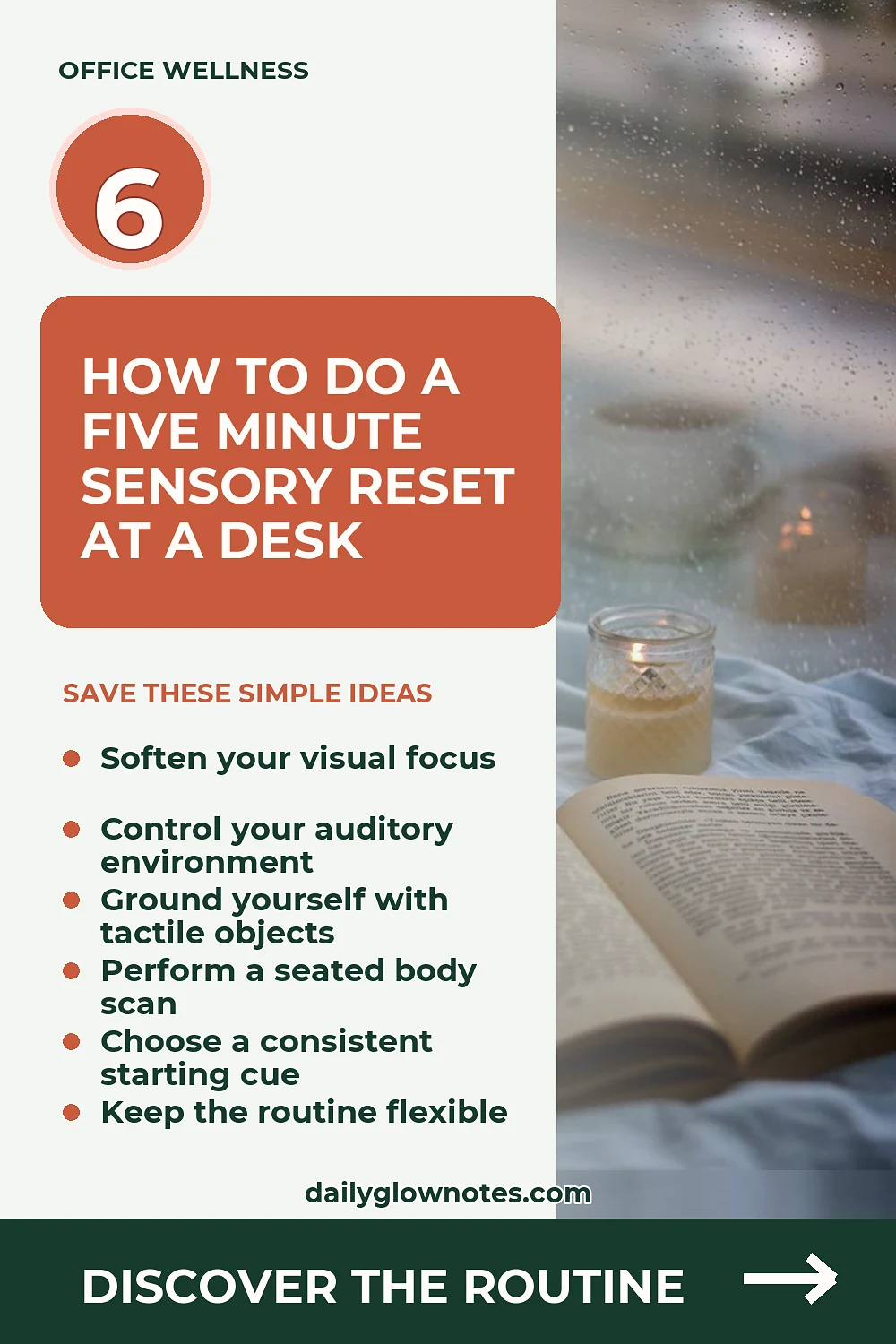
The hum of the office air conditioner, the persistent ping of incoming emails, and the visual clutter of open tabs can create a background noise that grates on your focus by mid-afternoon. When your workspace begins to feel like a pressure cooker, your ability to think clearly often takes a backseat to reactive stress. You do not need to leave the building or clear your entire schedule to reclaim your composure. A five-minute sensory reset at a desk can be the difference between a frazzled finish to your day and a calm, productive transition into your evening.
This troubleshooting approach treats your workspace not just as a location for tasks, but as a sensory environment that you have the power to recalibrate. By intentionally shifting your focus away from the screen and toward your immediate physical surroundings, you can signal to your nervous system that it is safe to downshift from high-alert mode.
Mapping Your Sensory Overload Triggers
Before you can reset, you need to identify what is actually pulling your attention away. Most office environments are designed for efficiency, not necessarily for human comfort. The lighting is often too harsh, the air is too dry, and the soundscape is filled with unpredictable mechanical or human noises. When you feel that tightness in your chest or the urge to snap at a coworker, pause for ten seconds to scan your environment.
Ask yourself: Is it the visual noise of a messy desktop? Is it the repetitive sound of a nearby conversation? Is it the feeling of stiffness in your shoulders from sitting in one position too long? Often, we blame the workload for our stress, but the physical environment is an accomplice. Once you identify the primary irritant, you can apply a specific sensory intervention rather than just trying to power through the discomfort. If you find your mornings are particularly difficult, you might also find value in exploring 3 Tiny Resets for Morning Inbox Overload Before It Takes Over, which helps set a more manageable tone for the hours ahead.
The Visual Softening Technique
Our eyes are often the first victims of a high-pressure office. Staring at a monitor for hours locks your gaze into a fixed focal length, which can inadvertently signal to your brain that you are in a state of high-alert, "fight or flight" scanning. To break this cycle, you need to deliberately change your visual field.
Start by looking away from your screen. Find a point in the distance—ideally, look out a window at a tree, a building, or the horizon. If you do not have a window, find an object on your desk that has texture, like a succulent or a notepad. Soften your gaze. Do not stare intently; let your eyes relax as if you are looking at a landscape painting. Spend sixty seconds simply observing the details of that object—the variations in color on a leaf, the texture of the paper grain. This micro-break tells your brain that you are not under an immediate threat, allowing your heart rate to settle slightly.
Auditory Anchoring with Ambient Control
Office sounds can be a major source of subconscious strain. The brain is wired to monitor background noise for potential threats, which means that even "background" chatter or office humming can drain your cognitive battery. When you cannot control the volume of the office, you must control your intake.
Consider using noise-canceling headphones, but instead of listening to high-energy music, opt for soundscapes that lack lyrics and predictable rhythms. Brown noise or low-frequency ambient sounds can mask the sharper, more jarring noises of an office. If headphones are not an option, practice a simple auditory focusing exercise. Close your eyes and identify the three most distant sounds you can hear. Then, identify the three closest sounds. This shifting of attention helps you regain a sense of agency over your auditory environment, preventing the "background noise" from becoming a source of internal static.