
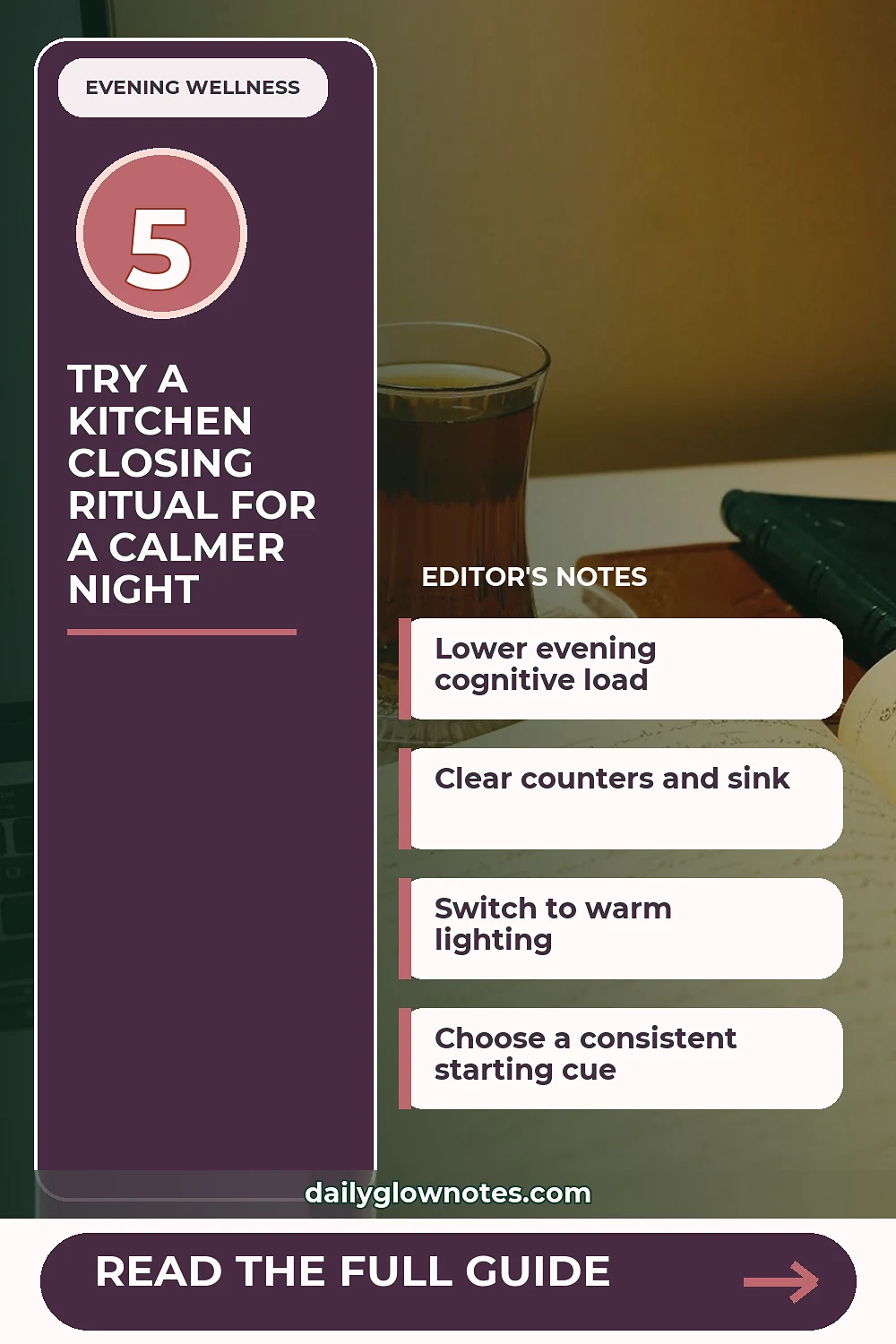
For many adult women, the hardest part of ending the day isn't crawling into bed—it is turning off the mental checklist that runs quietly in the background. You finish dinner, clear the plates, and step away, but your brain remains tethered to the unfinished details of the home. A sink with a few leftover dishes or a cluttered counter acts as a visual lingering task, signaling to your nervous system that the day's work is not quite complete. Establishing a kitchen-closing ritual for a calmer night offers a practical, physical anchor that tells your mind it is finally safe to rest.
By treating the kitchen reset not as a tedious chore, but as a deliberate boundary between active evening duties and quiet personal time, you transform a mundane space into a signal for relaxation. When the kitchen is officially 'closed,' your mind learns to drop the ongoing inventory of household management.
The Psychology of Environmental Closure
Our living spaces continually communicate with our nervous system. A kitchen left mid-task creates cognitive load, a concept in psychology where unfinished environmental cues keep our focus subtly engaged. When you walk past a messy counter on your way to bed, your brain registers an unfulfilled obligation. This prevents you from fully settling into a restful evening routine.
Creating a formal closing sequence changes that relationship. Much like a business hanging a 'Closed' sign in the window, completing a short, repeatable series of actions creates a clear sensory boundary. The physical transition of dimming the main lights and wiping the sink acts as a cue for your body to shift out of high-alert productivity and into a calmer state.
Step 1: Clear the Surfaces and Reset the Sink
The core of a kitchen closing ritual isn't deep cleaning; it is visual restoration. Start by taking ten minutes to move items back to their designated spots. Stack the dishwasher or quickly wash the remaining cookery, leaving the sink completely empty and dry. Wipe down the main counters so they present a clean, uninterrupted sightline for the morning ahead.
To make this step feel less like work and more like a gentle wind-down, keep it limited in scope. You are not scrubbing baseboards or organizing drawers. The goal is simply to return the room to a neutral state. When you walk into a clean kitchen the following morning, you begin the day with a sense of spaciousness rather than an immediate backlog of tasks.
Step 2: Transition the Lighting and Atmosphere
Once the physical clutter is cleared, shift the sensory ambiance of the space. Bright overhead fluorescent lights keep the body in an alert, daytime mode by suppressing natural melatonin production. As you finish your visual reset, turn off the central lights and switch on a single, warm counter lamp or a soft warm accent light.
This simple change in light temperature drastically alters the energy of the home. It signals that active work in the kitchen is done for the night. If you enjoy soothing hot drinks, this is the ideal moment to steep a cup of herbal chamomile or peppermint tea, allowing the gentle steam and warmth to further deepen your physical relaxation.